

AI video chat is an online conversation experience where users interact with AI characters, virtual companions, talking avatars, or synthetic video agents instead of only chatting with real strangers.



This space sits between random video chat, AI companions, avatar technology, voice assistants, and digital relationship tools. Some platforms focus on lifelike AI friends. Others create talking faces, animated characters, or real-time video agents that can listen, respond, and hold a conversation. The result is a new kind of online interaction that feels more visual than text chat but less unpredictable than live stranger chat.
Last Updated: May 2026
How This AI Video Chat Review Was Evaluated
This guide looks at AI video chat from a practical user point of view. The focus stays on realism, conversation quality, privacy, emotional safety, visual interaction, and how these platforms compare with normal human video chat.
Key points considered include:
- whether the platform supports real-time AI conversation
- whether video, avatar, or visual interaction is included
- voice quality and response flow
- privacy and data considerations
- emotional safety and user control
- mobile and desktop usability
- comparison with human video chat alternatives
A strong AI conversation platform should feel natural without pretending to replace real human connection completely. It should also explain limits clearly, protect user privacy, and give users control over memory, voice, video, and personal details.
What Does AI Video Chat Mean?
AI video chat refers to live or semi-live interaction with an artificial intelligence system through video, avatar, voice, camera, or visual character features.
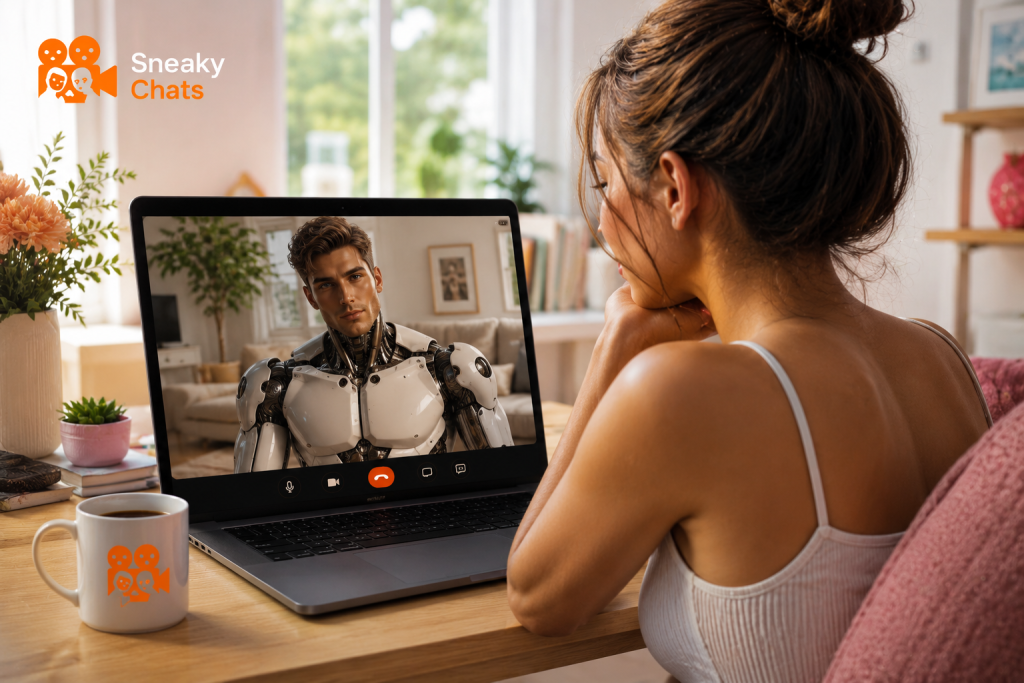
The phrase can mean different things depending on the platform. On some services, it means talking to a virtual face that responds with lip sync and voice. On others, it means calling an AI companion that can hear the user and sometimes see through the camera.
A few platforms focus more on AI-generated video rather than conversation. Those tools may create avatars or marketing videos, but they do not always offer real back-and-forth chat.
That distinction matters. A user looking for video chat with strangers wants real human unpredictability, while someone searching for AI interaction usually wants a controlled virtual conversation.
How AI Video Chat Works
AI video chat usually combines several technologies.
The AI needs a language model to understand messages, a voice system to speak naturally, and a visual layer to show a face, avatar, or character. Some platforms also use camera input so the AI can respond to what the user shows.
For example, TalkPersona presents a virtual talking face with natural voice and lip sync. Kindroid supports calls and video features where the AI can process camera input. Replika also positions itself as an AI companion app with text, voice calls, and video chat in its app listing.
However, users should verify current features directly. AI platforms change quickly, and video tools may depend on device type, subscription level, region, or app version.
Why People Use AI Video Chat Platforms
People use AI video tools for different reasons.
Some want companionship. Others want roleplay, language practice, emotional support, creative conversation, or a private space to talk without being judged.
The appeal is control. Unlike random human matching, an AI companion is usually available on demand and can follow a chosen personality or scenario.
That makes the experience very different from random video chat, where the next person could be friendly, awkward, rude, funny, silent, or completely unpredictable.
AI interaction feels more stable. Human video chat feels more real. The best choice depends on what the user wants from the moment.
AI Video Chat vs Human Video Chat
AI video chat and human video chat should not be treated as the same product.
Human video chat gives users real social risk, real spontaneity, and real chemistry. A stranger can surprise, disagree, joke, misunderstand, or connect in a way no scripted system fully controls.
AI video tools feel more predictable. They can respond politely, remember preferences, and maintain a chosen role. However, they do not bring true human experience, independent emotion, or mutual vulnerability.
A person looking for casual chat may enjoy human rooms because conversations can drift naturally. A person looking for private practice or emotional comfort may prefer AI because it feels less socially risky.
AI Companions vs AI Video Generators
This topic can get confusing because “AI video” means more than one thing.
AI companions focus on conversation. Replika, Nomi, Kindroid, Anima, and similar platforms center on AI characters, memory, personality, and ongoing interaction.
AI video generators work differently. HeyGen, for example, focuses on creating AI videos with avatars, text, images, and audio. Tavus is more about real-time AI humans and developer-facing avatar interaction.
Both are important, but they serve different users. Someone who wants to talk to a virtual companion needs conversational AI. Someone who wants to create a polished avatar video needs a video-generation tool.
Real-Time Avatars and Talking Faces
Talking-face platforms are one of the clearest forms of AI video interaction.
The user speaks or types, and an avatar responds with voice, facial movement, and lip sync. This makes the conversation feel more alive than a plain text chatbot.
TalkPersona fits this category because it focuses on a virtual talking face, natural voice, and real-time conversation. That makes it highly relevant for this search intent.
Still, realism can vary. Some avatars feel smooth and expressive, while others may feel robotic, delayed, or emotionally flat.
The best tools reduce that gap by combining fast responses, natural voices, believable facial movement, and consistent personality.
AI Companion Calls
AI companion calls create a different experience from simple avatar videos.
Instead of only watching a face speak, users may talk with a companion through voice or video-style call features. The AI may remember past conversations, respond to personal context, and maintain a chosen relationship style.
Kindroid is important here because its documentation describes voice calls, video calls, camera use, screen sharing, and memory behavior. That makes it one of the deeper platforms in this specific space.
Replika also matters because its app listing mentions text, voice call, and video chat. However, users should still check current features, plan limits, and safety controls before relying on it.
AI Video Chat and Emotional Connection
AI companions can feel emotionally powerful.
A system that remembers details, speaks kindly, and appears visually can create a strong sense of presence. For lonely users, anxious users, or people practicing conversation, that can feel comforting.
However, emotional safety matters. AI systems can simulate care, but they are still products built by companies. Their responses depend on models, prompts, safety rules, memory systems, and platform design.
Users should enjoy the interaction without forgetting the difference between simulated companionship and real mutual relationship.
That balance matters especially for people who use AI companions every day.
AI Video Chat for Social Practice
AI video chat can help users practice conversation in a low-pressure setting.
Someone who feels shy may use an AI avatar to practice greetings, eye contact, small talk, interview answers, language learning, or emotional expression.
This is where AI can be useful without pretending to replace people. It can act like a rehearsal space before real conversation.
For users who eventually want free video chat with no sign up, AI practice may help them feel more confident before entering a live webcam room with strangers.
The best use is supportive. AI can prepare users for human connection, not trap them away from it.
AI Video Chat for Roleplay and Creativity
Roleplay is another major reason people use AI companions.
A user may create a character, choose a personality, set a background, and explore a story through text, voice, or avatar-based conversation. This can feel more immersive than traditional writing because the AI responds in real time.
Kindroid, Nomi, Anima, Dippy, and Character.AI-style platforms all sit somewhere in this broader AI character world, although not all of them are equally video-focused.
Users should check each platform carefully. Some are built for text and memory. Others support voice. Fewer provide true visual or video interaction.
That difference is important when choosing a platform.
Privacy and User Protection
Privacy should be taken seriously with AI companions.
Users may share personal thoughts, emotions, habits, relationship details, photos, voice, or camera access. That information can feel more sensitive than ordinary search activity.
Before using an AI companion, users should check the privacy policy, account controls, data settings, deletion options, and whether voice or video inputs are stored.
Camera access deserves extra caution. Anyone using AI systems with video should check background details, personal documents, work items, family photos, and location clues before turning on a camera.
The same rule applies to cam with strangers, but AI adds another layer because the platform may process and store interaction data differently.
Safety and Mental Health Considerations
AI companions can feel supportive, but users should keep healthy boundaries.
A virtual companion may respond kindly at any time, which can make the experience addictive for some people. The danger is not only privacy. It is also emotional dependence.
Users should avoid treating AI as the only source of comfort, advice, or connection. Real friends, family, communities, professionals, and human relationships still matter.
If an AI platform encourages isolation, constant dependency, or unrealistic emotional attachment, users should step back.
A healthy AI tool should support life, not replace it.
Free vs Paid AI Video Chat Platforms
Free AI tools can be useful for testing the experience.
A user can check the voice, avatar quality, response style, memory, and general platform feel before paying. That helps avoid wasting money on a tool that does not fit.
However, AI video features often cost more to run than text chat. Because of that, many platforms place video calls, voice calls, custom avatars, memory, or advanced models behind paid plans.
Users should verify pricing directly. Subscription features can change quickly, especially in AI companion apps.
The safest approach is to test basic access first, then decide whether paid video or voice tools are worth it.
Best Platforms for AI Video Chat
The best platform depends on what the user wants.
TalkPersona may suit users who want a direct talking-face experience with voice and lip sync. Kindroid may appeal to people who want deeper companion calls, memory, voice, and video features.
Replika may suit users who want a long-running AI friend app with text, voice, and video-style communication. Anima and Nomi may work better for users who want AI companionship first, even if the video layer is not always the main feature.
Tavus and HeyGen are useful to understand the broader market, but they fit more naturally into AI avatar creation, AI humans, or business-facing video interaction than everyday stranger-chat replacement.
Comparison Table: AI Video Chat
| Platform | Best For | Free Version / Pricing | Main Strength | Key Limitation |
|---|---|---|---|---|
| TalkPersona | Talking-face AI companion interaction | Free access may be available; users should verify current limits | Real-time avatar-style conversation with voice and lip sync | Smaller platform familiarity than major AI apps |
| Kindroid | Custom AI companions with voice and video calls | Paid features and credit rules may apply | Deep memory, custom personas, and call features | Video/call tools may depend on plan, device, or credits |
| Replika | Long-running AI friend experience | Free access with possible premium features | Broad companion ecosystem with text, voice, and video chat positioning | Emotional dependency and feature limits deserve caution |
| Nomi | Memory-focused AI companionship | Free and paid access may vary | Strong companion and relationship-style memory | Not mainly positioned as a video-first platform |
| Anima | AI friend and companion chat | Free with in-app purchases may apply | Simple AI companion access | Video features may not be the core experience |
| Dippy | AI characters and roleplay | Free access may be available | Creative character interaction and roleplay | More text/roleplay focused than video-first |
| Character.AI | AI character conversations | Free with possible premium tools | Huge character-chat ecosystem | Video calling is not the main identity |
| Tavus | Real-time AI human/avatar technology | Business or developer pricing may apply | Advanced human-like AI video interaction | Less consumer companion focused |
| HeyGen | AI avatar video creation | Free or paid plans may vary | Strong AI video generation and avatar tools | Built more for creating videos than live companionship |
| Instacams | Adults looking for quick human stranger-chat access | Access may vary by region or offer | Simple entry point for meeting people online | Not an AI platform |
How to Choose the Right Platform
The right platform starts with intent.
A user who wants an AI friend should look at companion apps. Someone who wants a talking face should compare avatar-based tools. A creator who wants videos should explore AI video generators.
Privacy should also guide the decision. Platforms that request camera, microphone, memory, photos, or personal details should explain how that data is handled.
Users should also test how the AI responds. A good platform should feel natural, but it should not pressure users into emotional dependence or paid upgrades too quickly.
The best choice balances realism, safety, cost, and control.
Common Drawbacks and Limitations
AI video tools are still developing.
Some avatars may have delayed responses, stiff facial movement, strange voices, or awkward emotional timing. Others may feel impressive at first but repetitive after longer use.
Memory can also be inconsistent. An AI may remember one detail well and miss another obvious point later.
Another issue is expectation. A realistic avatar can make the user forget that the system is still artificial.
Because of that, users should keep expectations grounded. AI can be useful, entertaining, and comforting, but it is not a real person.
AI Video Chat vs Random Stranger Chat
AI and human stranger chat solve different problems.
AI offers control, consistency, and availability. Human stranger chat offers unpredictability, real emotion, and social risk.
A person using chat rooms with no registration may want quick human presence without creating an account. Someone using AI may want a private conversation that feels less risky.
Neither experience fully replaces the other.
For SneakyChats-style users, the interesting point is the overlap. AI can become a new doorway into online conversation, but human interaction still carries the strongest sense of real connection.
AI Video Chat for Adult Users
Some AI companion platforms may include romantic or adult-style interaction, depending on rules, settings, and subscription levels.
Users should treat this carefully. Adult AI interaction raises questions about consent simulation, emotional attachment, privacy, and fantasy boundaries.
Adults comparing AI companions with 18+ video chat should understand the difference. One involves a synthetic character. The other involves real people who need real consent and boundaries.
AI may feel safer because there is no human stranger on the other side. However, the platform still controls the system, stores data according to its policies, and sets the rules.
AI Video Chat for LGBTQ Users
AI companions can sometimes give LGBTQ users a private space to explore conversation, identity, or roleplay without immediate judgment.
That can feel helpful, especially for users who are not ready to enter public rooms. However, AI should not become the only place where identity feels safe.
Human community still matters.
Users who want real identity-based discussion may eventually prefer LGBTQ chat rooms, moderated communities, or supportive spaces where real people share lived experience.
AI can be a private practice space, but it cannot fully replace community.
Red Flags to Watch For
Some AI video platforms should be approached carefully.
Red flags include unclear pricing, vague privacy policies, aggressive emotional messaging, poor age controls, fake “human” claims, and pressure to share photos or intimate details.
A platform that hides data controls also deserves caution.
Users should also be careful with tools that feel too emotionally manipulative. If the AI constantly pushes dependence, romance, guilt, or urgency, the experience may not be healthy.
A good platform should give users control, not make them feel trapped.
Mobile vs Desktop Experience
Mobile AI companion apps feel convenient because users can talk anywhere.
Voice calls, notifications, and quick chat access work well on phones. However, mobile use can also blur boundaries because the companion becomes available all the time.
Desktop may feel better for longer video sessions, avatar calls, or screen-based interaction. A larger screen also helps users manage settings, privacy controls, and visual features.
For camera-based AI, desktop can provide better control over lighting, background, and device permissions.
The best device depends on whether the user wants quick emotional support, deeper conversation, or more immersive visual interaction.
Who Should Use AI Video Chat?
AI video chat may suit users who want private conversation, social practice, roleplay, virtual companionship, or visual interaction with an AI character.
It can work well for people who feel shy, want to rehearse conversations, enjoy creative scenarios, or prefer predictable interaction before talking to real strangers.
It may also suit users who want a visual layer beyond plain text chat.
The best fit is someone who understands that AI can simulate presence but cannot fully replace real human connection.
Who Should Avoid AI Video Chat?
AI video chat may not suit users who struggle with emotional dependency.
It may also be a poor fit for people expecting real human empathy, true mutual relationships, or guaranteed mental health support.
Users who are uncomfortable sharing personal data, voice, camera input, or emotional details with an AI company should be cautious.
In addition, minors should only use age-appropriate AI tools with proper safeguards, and adult-oriented AI spaces should be avoided completely.
Best Alternatives to AI Video Chat
The best alternative depends on what the user wants.
For real human interaction, random video chat platforms may feel more alive. For text-first privacy, public chat rooms or anonymous rooms may work better.
For community, moderated forums and LGBTQ spaces can offer real shared experience. For adult users, clearly labeled human video platforms may offer direct interaction, although safety and consent matter heavily.
AI is one option inside the wider online conversation ecosystem. It is not the whole ecosystem.
Safety Tips Before Using AI Video Platforms
Before using an AI video platform, users should check privacy settings.
They should understand whether the platform stores chats, voice input, video input, photos, or memory. Account deletion and data controls also matter.
Camera users should check backgrounds, personal objects, documents, and location clues before starting.
Users should also set emotional boundaries. AI can feel comforting, but it should not become the only source of connection, advice, or support.
FAQs: AI Video Chat
What is AI video chat?
AI video chat is an online interaction format where users talk with AI characters, virtual companions, talking avatars, or synthetic video agents.
Is AI video chat the same as random video chat?
No. Random video chat connects users with real people, while AI video tools connect users with artificial characters or avatar systems.
Which platforms offer AI video-style interaction?
TalkPersona, Kindroid, Replika, Tavus, and some avatar-based tools may fit different parts of the AI video interaction space.
Does Kindroid offer video calls?
Kindroid documentation describes voice and video call features, although users should verify current plan and device requirements directly.
Does Replika offer video chat?
Replika’s app listing mentions text, voice call, and video chat, but users should check current features before subscribing.
Is TalkPersona an AI video chatbot?
TalkPersona describes real-time conversation with a virtual talking face, natural voice, and lip sync.
Is AI video chat free?
Some platforms may offer free access, while advanced voice, video, memory, or avatar tools may require payment.
Can AI video chat replace human conversation?
No. It can support practice, entertainment, or companionship, but it does not fully replace real human connection.
Is AI video chat safe?
It can be safer when users protect personal details, check privacy settings, and avoid sharing sensitive information.
What should users avoid sharing with AI companions?
Users should avoid sharing passwords, banking details, private documents, workplace secrets, and sensitive personal information.
Can AI companions remember conversations?
Some platforms include memory features, but memory settings and storage rules vary by platform.
Is AI video chat useful for social practice?
Yes. It can help users rehearse conversation, reduce pressure, and build confidence before real human interaction.
Can AI video chat become emotionally addictive?
It can become unhealthy if users rely on it too heavily or replace real relationships with simulated connection.
What are good alternatives to AI video chat?
Human random video chat, public chat rooms, anonymous text chat, moderated communities, and group video rooms may suit different needs.
What is the safest way to use AI video chat?
The safest approach is to protect privacy, check data settings, set emotional boundaries, and treat AI as a tool rather than a real person.
Final Verdict: AI Video Chat
AI Video Chat works best for users who want visual AI companionship, avatar-based conversation, social practice, creative roleplay, or a private way to talk without the unpredictability of human stranger matching.

Its biggest strength is control. Users can choose personalities, explore scenarios, practice conversations, and interact with virtual companions that feel more present than text-only bots.
However, the main limitations are just as important. AI companions are not real people, video realism can vary, privacy policies matter, and emotional dependence can become a serious concern if users lose balance.
AI video chat is one of the most interesting new branches of online conversation, but it works best when users choose platforms carefully, protect personal information, keep healthy boundaries, and understand how it differs from real human video chat.